
Train Your State. Expand Your Capacity.
Secular, science-based breathwork and somatic exercises for high performance and restoration.
Your physiology changes with what life asks of you.
Deep concentration requires something different from physical exertion. Performing under pressure requires something different from recovering after it. And sometimes the problem isn't that you need to relax — it's that you need to become more alert, focused and ready to act.
Breathful Balance uses applied respiratory physiology, breathwork and somatic exercises to help you work deliberately with those changing demands.
The aim is not permanent calm.
It is the capacity to activate, regulate, perform and restore when you need to.
Your State Is Not Supposed to Stay the Same
Your nervous system is designed to change.
It mobilizes resources when demands increase, adjusts breathing and cardiovascular activity to support action, and shifts toward recovery when those demands have passed.
Problems arise when that flexibility becomes limited — when breathing mechanics are inefficient, activation becomes difficult to regulate, recovery is incomplete, or the body keeps responding as though the demand is still present.
Breathful Balance approaches these processes as trainable physiology.
Rather than treating breathwork as a collection of generic breathing exercises, the methodology considers respiratory mechanics, autonomic state and measurable physiological adaptation together.
The goal is not to force the nervous system into one supposedly ideal state.
The goal is greater physiological flexibility and capacity.
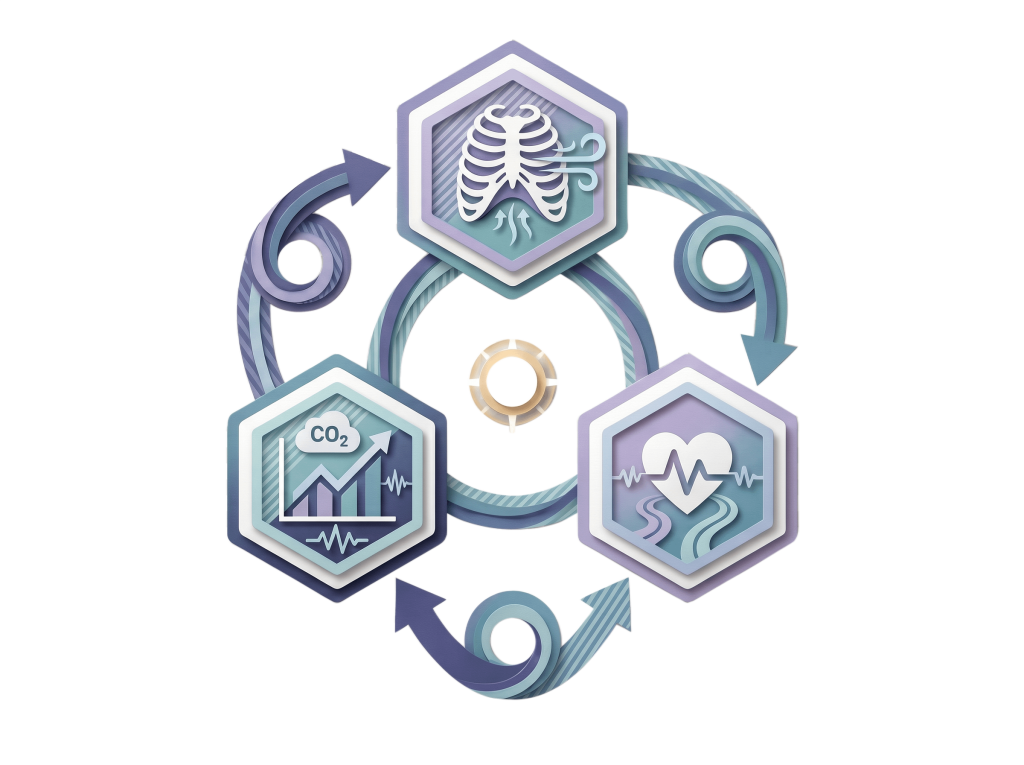
The Three Pillars of Our Methodology
Breathing techniques can only work with the mechanics available to them.
Breathful Balance begins with the physical foundations of breathing: diaphragmatic function, rib-cage movement, respiratory coordination and patterns of muscular compensation.
Where those mechanics are inefficient, the priority is not simply to breathe more slowly or deeply. It is to improve the physical system producing the breath.
Different situations require different physiological states.
Some require alertness, mobilisation and rapid execution. Others require sustained concentration, controlled regulation or deep recovery.
Breathful Balance uses specific respiratory patterns, breath rates, rhythms and somatic exercises to influence arousal deliberately rather than assuming that every breathing practice should make you calmer.
The objective is state flexibility: developing a greater ability to move between activation and recovery according to what the situation actually requires.
Physiological training should not depend entirely on how something feels.
Breathful Balance incorporates measurable indicators such as respiratory rate, carbon-dioxide tolerance and other relevant psychophysiological measures to establish baselines, monitor adaptation and inform progression.
Measurement is not there to turn the body into a spreadsheet.
It provides another source of information for determining whether the underlying system is actually changing.
Breathwork Is a Tool, Not the Goal
Breathing sits at an unusual intersection of voluntary control and automatic physiology.
That makes it useful.
Changing how you breathe can alter respiratory chemistry, mechanical loading and autonomic activity. Somatic exercises provide additional ways of working with sensory input, muscular tension, movement and physiological state.
But Breathful Balance is not built around performing breathing exercises for their own sake.
The techniques are used according to the outcome required.
Focus. Readiness. Regulation. Recovery. Respiratory function. Adaptation.
Different objectives require different tools.
High Performance Includes Recovery
Performance is not simply the ability to produce more.
A system that can mobilise but cannot recover is not functioning optimally. Neither is one that can relax but struggles to generate sufficient activation when demands increase.
Sustainable performance requires both.
Breathful Balance therefore treats restoration as part of performance physiology rather than its opposite.
Start With Your Nervous System
Before changing something, it helps to understand what it is currently doing.
The Free Nervous System Check provides a starting point for examining patterns associated with activation, regulation and recovery.