You’re stressed, so you take a big gulp of air. It feels like the right move, and in my experience it’s the most common breathing mistake among smart, driven people.
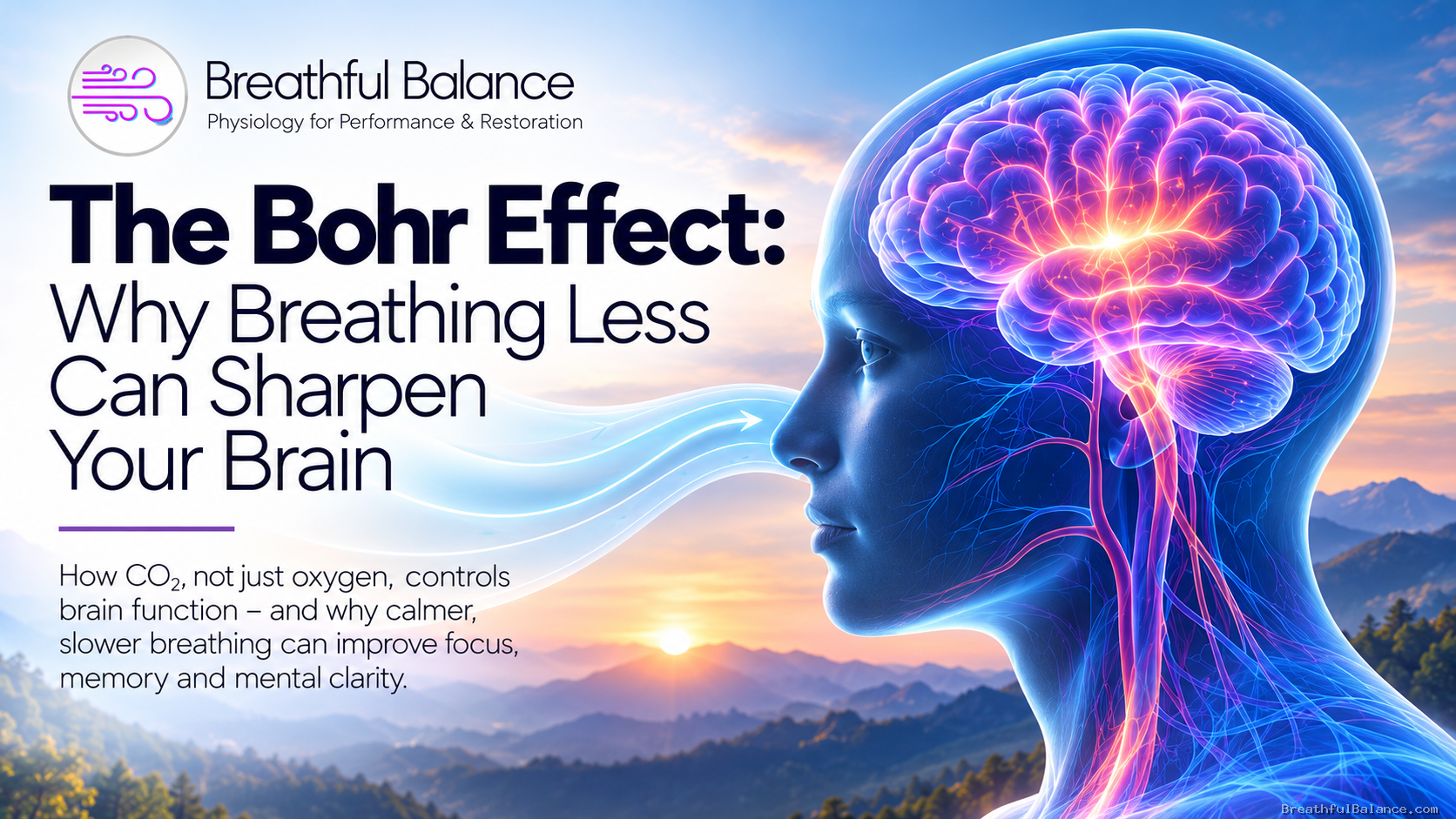
Over-breathing can reduce how much oxygen your brain tissue receives. Brain fog, mid-afternoon mental fade, and a low hum of agitation often trace back to a breathing pattern that looks like relaxation and works against you.
The Bohr effect in plain terms
Most people assume bigger breaths mean more oxygen for the brain. Your arterial blood is usually close to fully saturated already, so a bigger breath adds very little. Getting oxygen into your blood is rarely the problem. Getting it out of your blood and into your tissue is.
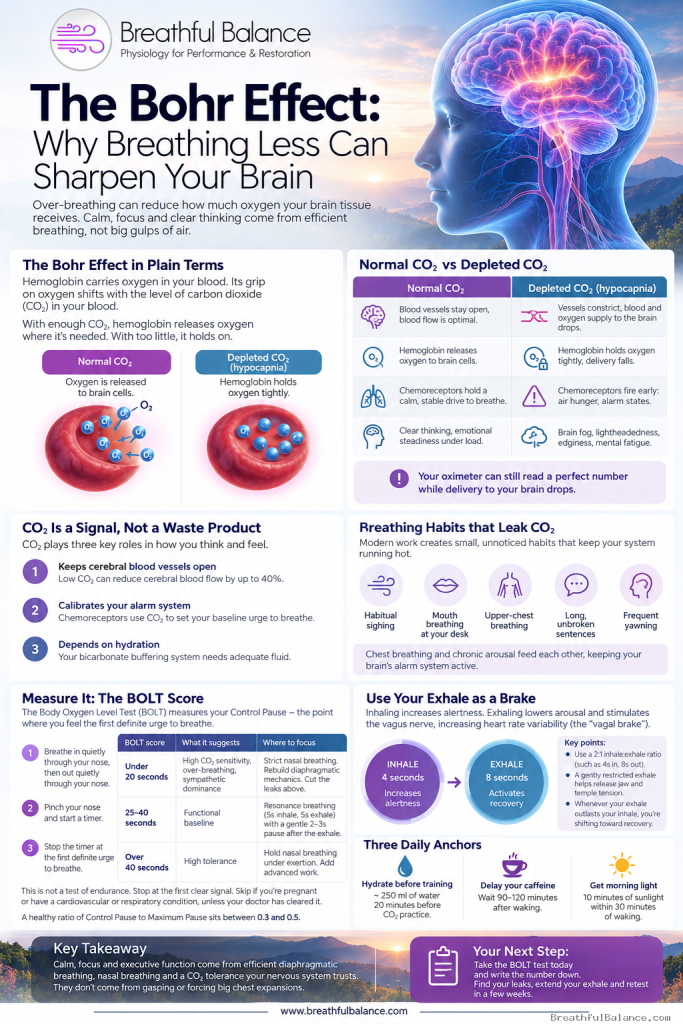
That handoff is controlled by the Bohr effect: hemoglobin’s grip on oxygen shifts with the level of carbon dioxide (CO₂) in your blood. With enough CO₂, hemoglobin releases oxygen where it’s needed. With too little, it holds on.
Over-breathe through frequent sighing, chest breathing, or habitual mouth breathing, and you blow off CO₂ faster than your body makes it. This state is called hypocapnia. Your oximeter can still read a perfect number while delivery to your brain drops.
CO₂ is a signal, not a waste product
CO₂ gets treated as exhaust. In practice it does three jobs that matter for how you think and feel:
- It keeps cerebral blood vessels open. In hypocapnia, the vessels supplying your brain constrict. Reductions in cerebral blood flow of up to 40% are cited in the physiology literature for pronounced over-breathing.
- It calibrates your alarm system. Chemoreceptors in your brainstem use CO₂ to set your baseline urge to breathe. Low tolerance means a hair-trigger. You feel air hunger and a jolt of arousal over a minor fluctuation.
- It depends on hydration. Your bicarbonate buffering system manages blood pH, and it needs adequate fluid to do that job. Dehydration can make your breathing alarms more sensitive.
| Normal CO₂ | Depleted CO₂ (hypocapnia) |
|---|---|
| Blood vessels stay open, blood flow is optimal | Vessels constrict, blood and oxygen supply to the brain drops |
| Hemoglobin releases oxygen to brain cells | Hemoglobin holds oxygen tightly, delivery falls |
| Chemoreceptors hold a calm, stable drive to breathe | Chemoreceptors fire early: air hunger, alarm states |
| Clear thinking, emotional steadiness under load | Brain fog, lightheadedness, edginess, mental fatigue |
Your breathing habits are probably leaking CO₂ all day
Modern work creates small, unnoticed breathing habits that keep your system running hot. I call them “cortisol leaks” because they sustain sympathetic arousal without you noticing:
- Habitual sighing. Each sigh dumps CO₂.
- Mouth breathing at your desk. It moves air fast and skips the nose’s regulating effect.
- Upper-chest breathing. It recruits the scalenes, sternocleidomastoid, and pectoralis minor, muscles that burn several times more energy than the diaphragm for the same job.
- Long, unbroken sentences. Talking without a nasal reset pushes you toward over-breathing.
- Frequent yawning. It’s often a sign of disordered breathing volume rather than tiredness.
Chest breathing and chronic arousal feed each other. The brainstem’s arousal center, the locus coeruleus, runs in sync with your breath, and sustained effort at the neck and chest keeps it firing. You can see the result: a clenched jaw, tight temples, shoulders creeping toward your ears. I treat those as data.
Sustained stress also takes a toll on the brain. Robert Sapolsky’s research on chronic glucocorticoid exposure links prolonged stress to reduced gray matter in the prefrontal cortex and hippocampus, the regions you rely on for planning and emotional control.
Measure it: the BOLT score
You can’t improve CO₂ tolerance without a baseline. The Body Oxygen Level Test (BOLT) measures your Control Pause, the point where you feel the first definite urge to breathe.
- Breathe in quietly through your nose, then out quietly through your nose.
- Pinch your nose and start a timer.
- Stop the timer at the first definite urge to breathe or the first involuntary movement of your breathing muscles, such as a swallow or a contraction in your abdomen.
This is not a test of endurance. Stop at the first clear signal, then breathe normally through your nose. Skip breath-hold testing if you’re pregnant or have a cardiovascular or respiratory condition, unless your doctor has cleared it.
| BOLT score | What it suggests | Where to focus |
|---|---|---|
| Under 20 seconds | High CO₂ sensitivity, over-breathing, sympathetic dominance | Commit to strict nasal breathing. Rebuild diaphragmatic mechanics. Cut the leaks above. |
| 25–40 seconds | Functional baseline | Resonance breathing (5-second inhale, 5-second exhale) with a gentle 2–3 second pause after the exhale. |
| Over 40 seconds | High tolerance | Hold nasal breathing under exertion. Add advanced hypoventilation work. |
Your Control Pause (first urge) and your Maximum Pause (the longest you can hold) are different measures. A healthy ratio of CP to MP sits between 0.3 and 0.5. Below 0.3 points to over-sensitivity to CO₂, regardless of willpower.
Three daily anchors that support the work
- Hydrate before training. Drink about 250 ml of water roughly 20 minutes before CO₂ tolerance practice.
- Delay your caffeine. Wait 90–120 minutes after waking so your natural cortisol awakening response can run its course before you stack a stimulant on top.
- Get morning light. Ten minutes of outdoor sunlight within 30 minutes of waking helps anchor your circadian rhythm.
Use your exhale as a brake
Your breath and your arousal system run in sync. Inhaling lifts norepinephrine firing, heart rate, and alertness. Exhaling lowers firing and stimulates the vagus nerve, which increases respiratory sinus arrhythmia, the breath-linked rise and fall of your heart rate. Stephen Porges calls this the “vagal brake.”
You can use it on demand. Inhale through your nose for 4 seconds and exhale for 8, or hold any 2:1 ratio. A gently restricted exhale, through softly pursed lips or a narrowed nasal airflow, adds mild resistance and helps release jaw and temple tension. Whenever your exhale outlasts your inhale, you’re shifting your system toward recovery and away from alarm.
What to take from this
Calm, focus, and executive function come from efficient 360-degree diaphragmatic movement, nasal breathing, and a CO₂ tolerance your nervous system trusts. They don’t come from gasping or forcing big chest expansions.
Find your leaks, take your BOLT score, extend your exhale, and retest in a few weeks. The number will show you whether your habits are working.
Your next step: take the BOLT test today and write the number down.
2 thoughts on “The Bohr Effect: Why Breathing Less Can Sharpen Your Brain”