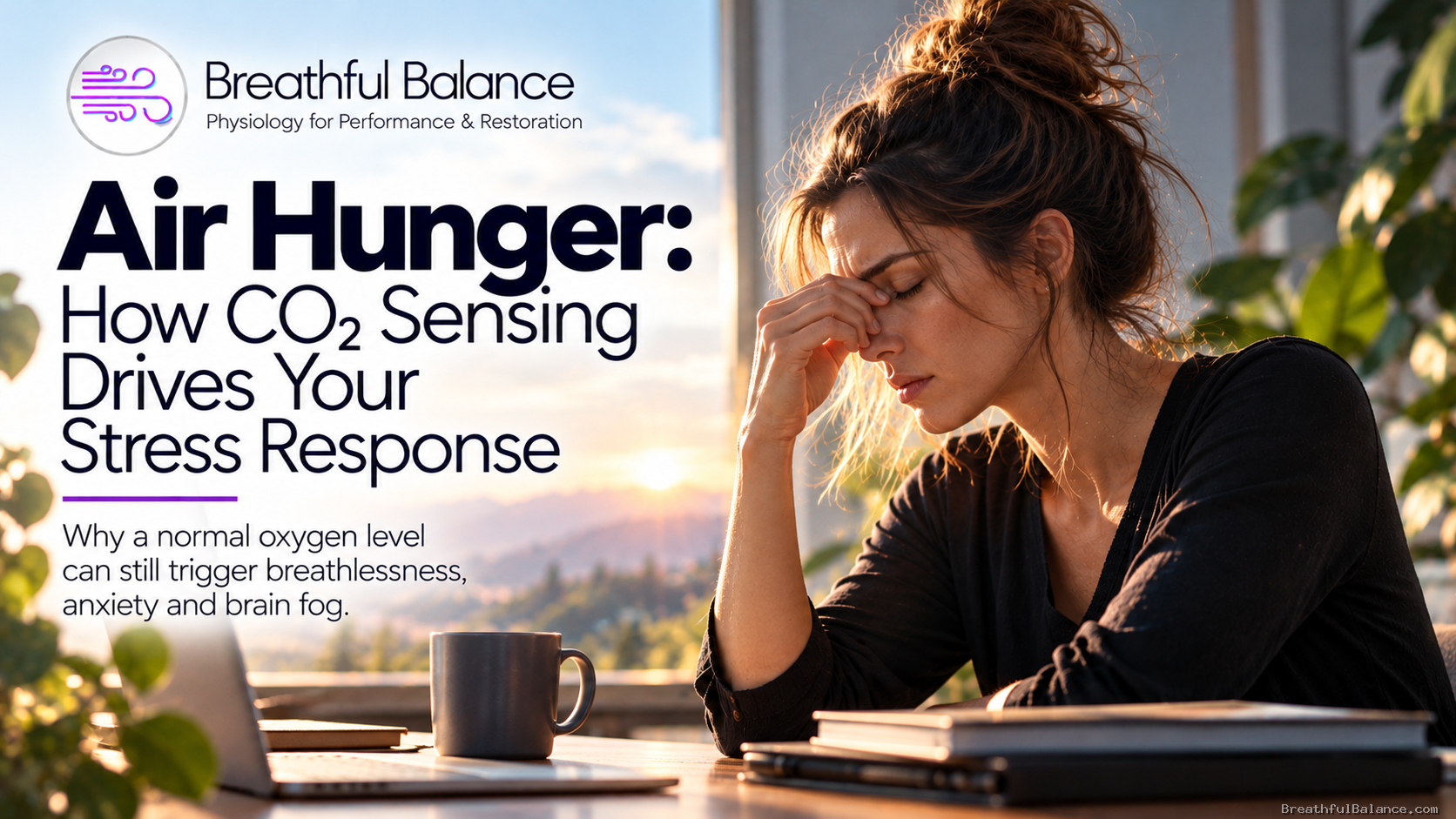
You’re at your desk doing something routine and a wave of unease arrives from nowhere. Your chest tightens, your thinking goes foggy, and you get a faint sense that you can’t quite get a full breath. Most people call this stress, exhaustion, or a lack of fresh air.
In my experience, that diagnosis is often wrong. The sensation is usually generated by your brainstem’s breathing sensors, and it can show up with perfectly normal blood oxygen. What feels like emotional panic is frequently a misread of your own blood chemistry.
It’s CO₂, not oxygen, that sets off air hunger
Most people believe falling oxygen is the body’s main cue to breathe. Day to day, it isn’t. Carbon dioxide (CO₂) is the dominant driver of your breathing rate and depth. Chemoreceptors in the medulla of your brainstem track arterial CO₂ and blood pH continuously and use them to set your urge to breathe. Oxygen sensors elsewhere in the body matter mostly when oxygen drops substantially.
As your metabolism produces CO₂, it builds up in the blood. When it crosses a threshold, your chemoreceptors signal an inhale, well before oxygen is in short supply. If your CO₂ tolerance is low, that threshold sits too early. A minor fluctuation registers as an emergency, and you get air hunger, breathlessness, and a surge of sympathetic arousal over very little.
Good CO₂ tolerance means your system stays neutral under metabolic pressure. Small shifts pass without triggering a panic-breathing response. That neutrality is the foundation for steady focus and steady mood.
Over-breathing makes it worse
When you feel breathless, the instinct is to breathe bigger and faster: chest breathing, sighing, mouth breathing. It feels like the solution and it usually deepens the problem.
Over-breathing washes out CO₂, a state called hypocapnia. Through the Bohr effect, hemoglobin holds oxygen more tightly when CO₂ is low, so less is released to your tissues. Low CO₂ also constricts cerebral blood vessels and reduces blood flow to the brain. Your saturation can read close to 100% while delivery to your brain falls. The result is brain fog, lightheadedness, and a persistent low-level unease.
| Habitual over-breathing (hypocapnia) | Balanced CO₂ |
|---|---|
| CO₂ is washed out | CO₂ stays in a healthy range |
| Hemoglobin holds oxygen tightly | Oxygen is released to brain and tissue |
| Cerebral vessels constrict, blood flow drops | Vessels stay open, perfusion is steady |
| Brain fog, lightheadedness, background anxiety | Clear thinking, steady focus, calm |
Your breath is wired to your arousal system
The brain’s main arousal center, the locus coeruleus (the “LC-NE system” for its norepinephrine output), fires in step with your breathing cycle, and inhale and exhale pull in opposite directions.
- Inhale is the accelerator. It raises LC-NE firing and releases a pulse of norepinephrine, which lifts cortical excitability and sharpens threat detection. That’s useful in short bursts. If your breathing pattern keeps your system in constant inhale-dominance, you carry a heavy load of arousal all day, and fatigue follows.
- Exhale is the brake. It lowers LC-NE firing and stimulates the vagus nerve (cranial nerve X), which increases respiratory sinus arrhythmia (RSA), the breath-linked rise and fall of heart rate. Autonomic balance shifts toward the parasympathetic side. Stephen Porges calls this the “vagal brake.”
That gives you a control you can use on demand. A longer exhale relative to your inhale moves your system toward recovery, and it takes effect while the circumstances around you stay exactly as they are.
Measure your sensitivity: the BOLT score
You don’t need a lab or a wearable to get a baseline. The Body Oxygen Level Test (BOLT), also called the Control Pause, gives you a simple marker of how sensitive your chemoreceptors are.
- Sit upright. Breathe in normally through your nose, then out normally through your nose.
- Pinch your nose and start a timer.
- Stop at the first definite urge to breathe or the first involuntary signal, such as a swallow or a twitch in your diaphragm.
This is not an endurance test. Stop at the first clear signal and return to easy nasal breathing. Skip breath-hold testing if you’re pregnant or have a cardiovascular or respiratory condition, unless your doctor has cleared it.
| BOLT score | What it suggests |
|---|---|
| Under 20 seconds | Over-breathing, high chemoreceptor sensitivity, high stress reactivity |
| 25–30 seconds | Typical baseline with balanced sensitivity |
| 40+ seconds | High CO₂ tolerance and low reactivity to air hunger |
Your score is also shaped by what you do between practice sessions. Mouth breathing while you concentrate, sighing, frequent yawning, and long unbroken sentences all wash out CO₂ and keep your chemoreceptors sensitive. I call these “leaks.” Fix the leaks and practise regularly, and your score rises.
Four practices that recalibrate the alarm
Each of these uses the exhale, CO₂ tolerance, or both. Keep every one of them comfortable. Strain defeats the purpose.
1. 4-8 breathing. Inhale through your nose for 4 seconds. Exhale through your nose or softly pursed lips for 8. The 1:2 ratio doubles the exhale and gives the vagal brake a strong signal.
2. Resonance breathing. Inhale through your nose for 5 seconds and exhale for 5, about six breaths per minute. This rhythm lines up your heart rate and breathing oscillations near 0.1 Hz, which tends to increase heart rate variability (HRV). Higher HRV is associated with better top-down regulation of threat responses by the prefrontal cortex.
3. The post-exhale pause. After a smooth, easy exhale, pause for 2 to 4 seconds before the next inhale. These short holds let CO₂ rise in small doses and can desensitize your chemoreceptors over time. Your bicarbonate buffering system manages pH during this process and needs adequate hydration, so drink about 250 ml of water before practice. If you feel strained or anxious, shorten the pause. Skip breath-hold work if you’re pregnant or have a cardiovascular or respiratory condition, unless your doctor has cleared it.
4. The physiological sigh. Take a deep nasal inhale to roughly 80% of capacity, follow it with a short second inhale through the nose, then let out a long, complete exhale through your mouth. The second inhale is thought to help re-expand collapsed air sacs in the lungs, and the long exhale then engages the vagal brake. It’s a quick tool for the moment a wave of tension arrives.
What to take from this
Air hunger and unexplained unease are often outputs of a nervous system responding to chemical feedback. That makes them trainable. You can’t fix them by gulping air. You can change them by understanding what your chemoreceptors are reacting to, cutting the habits that keep CO₂ low, and using your exhale deliberately.
Your next step: take your BOLT score today, write the number down, and run 4-8 breathing for two minutes tonight. Retest in two weeks.